Check out Threatveil's idea (demo vision) on demo.threatveil.com

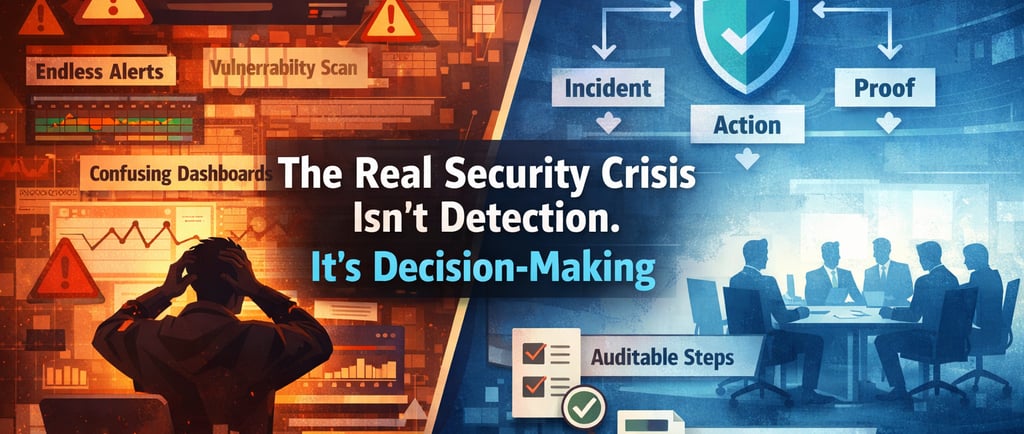
The Real Security Crisis Isn’t Detection. It’s Decision-Making.
The industry solved the wrong problem
2/5/20261 min read
For the last 20 years, cybersecurity focused obsessively on detection.
More scanners.
More alerts.
More dashboards.
And yet… breaches keep happening.
Why?
Because modern security failures are not detection failures — they’re decision failures.
Teams are overwhelmed with signals but lack:
clarity on what matters now
confidence in what to fix first
proof that actions actually reduced risk
Security didn’t become safer.
It became noisier.
Why alerts don’t protect organizations anymore
Most organizations today already know:
which assets they have
that vulnerabilities exist
that misconfigurations are present
that AI introduces new risks
What they don’t know is:
which of these issues deserve action
which ones can wait
which actions will actually reduce risk
how to explain those decisions to leadership or auditors
Security teams drown in data but starve for judgment.
The missing layer: security decision intelligence
This is the gap ThreatVeil exists to fill.
ThreatVeil doesn’t try to out-detect SIEMs or scanners.
It answers a harder question:
“Given everything we know right now, what should we do — and how do we prove it worked?”
Instead of endless alerts, ThreatVeil produces:
incidents (correlated storylines, not isolated findings)
decisions (explicit, auditable actions)
verification (evidence that risk actually went down)
This shifts security from monitoring to governance.
Why this matters at the board level
Boards don’t want CVEs.
They want answers:
Are we safer than last quarter?
Which risks were reduced?
What decisions mattered?
What proof do we have?
ThreatVeil turns technical security activity into executive-grade truth — without forcing companies to run a full SOC.
Detection finds problems.
Decisions reduce risk.
And that’s the future of cybersecurity.